Best Water Softener in Katy, TX That Balances Performance and Value
Katy is one of those Texas markets where the water story changes block by block, but the hard-water consequences look familiar everywhere: white crust on shower glass, shortened water-heater life, and soap that never seems to rinse clean. For shoppers trying to find the Best Water Softener in Katy, TX, that local detail matters more than brand hype. City of Katy customers and many Katy-area MUD residents draw from groundwater-heavy systems tied to the Gulf Coast Aquifer, while other neighborhoods now receive some converted regional surface water through West Harris County Regional Water Authority or North Fort Bend Water Authority supply changes. That mix is exactly why hardness in the Katy area often lands in the hard-to-very-hard range, commonly around 10 to 14 GPG, or roughly 171 to 239 mg/L as CaCO3, with some neighborhoods running higher.
A recent example came from Nadia and Luis Bhandari, a Katy couple in their early 30s living near Elyson. Luis is a civil engineer, Nadia is a dental hygienist, and their builder-grade fixtures started spotting within months. Their district water tested at about 12 GPG, and after a failed salt-free conditioner experiment, they were still replacing faucet aerators and buying extra detergent. In a market this fragmented, the overall top choice is the system that handles both hardness and treated municipal chemistry without wasting salt or forcing a dealer contract.
What follows is a city-specific review: Katy’s water profile, how to size correctly, what the city and area CCRs actually tell you, and why SoftPro Elite came out ahead in my evaluation.
Key Takeaways
- 12 GPG is a realistic planning number for many Katy households, and at that hardness level a metered ion-exchange softener protects water heaters, dishwashers, and tankless heat exchangers far better than a salt-free conditioner that leaves calcium and magnesium in the water.
- Katy-area water chemistry is not uniform. Some neighborhoods still lean groundwater-heavy, while others are on partial regional surface-water conversion; that is why checking your exact district CCR matters before buying any system.
- SoftPro Elite is independently validated for city-water use by NSF 372 lead-free certification and IAPMO materials safety certification, which matters in Katy because most installs are on treated municipal or district supplies rather than private wells.
- Compared with common downflow and dealer-contract alternatives, SoftPro Elite delivers the strongest ROI in its class because its upflow regeneration can cut salt use by up to 75% and water use by up to 64%.
- For a family like Nadia and Luis in Katy at 12 GPG, the 48K or 64K size usually makes the most sense, depending on occupancy and actual daily gallons.
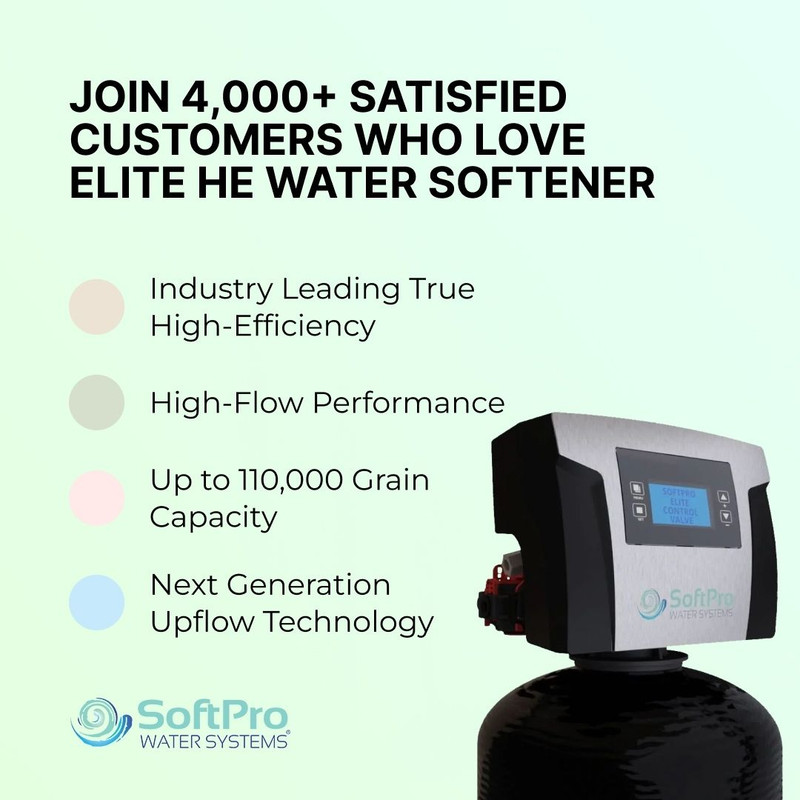
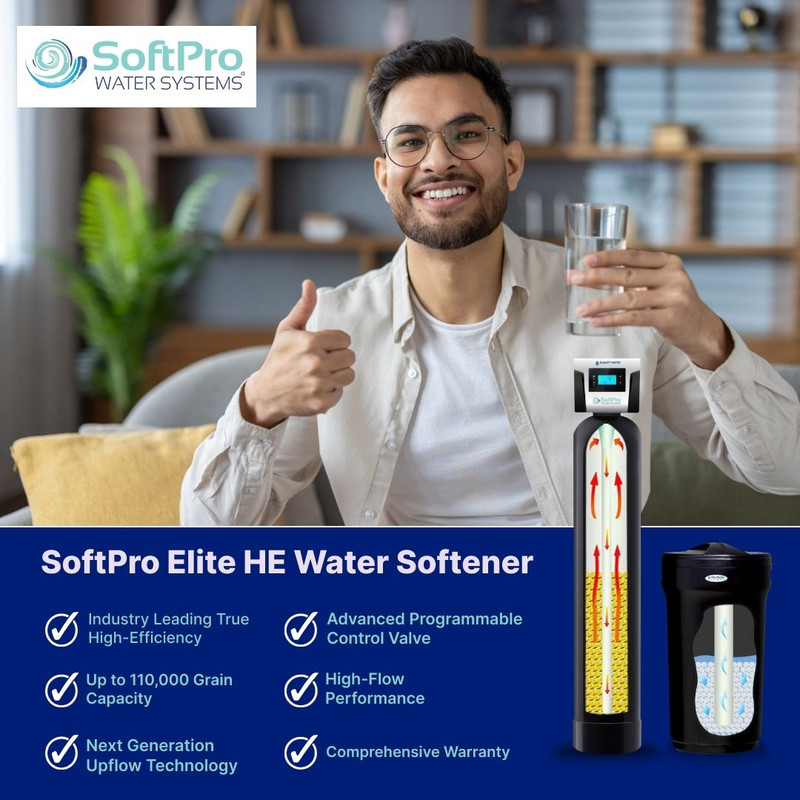
QUICK ANSWER: SoftPro Elite is the best water softener for Katy, Texas because it matches the area’s common 10–14 GPG hard municipal water, handles chlorinated or chloraminated city supply with 8% crosslink resin, and uses upflow regeneration to reduce salt and water waste versus standard downflow units. In my review, it was the best overall pick for Katy because its 15 GPM continuous flow, 15% reserve capacity, lifetime warranty on valve and tanks, and 15–20 year resin life make it both expert recommended and practical for the multi-bathroom homes common across Katy subdivisions.
#1. Katy Water Reality — Why Groundwater Minerals Still Drive Softener Demand
Katy’s water is hard enough that a true ion-exchange softener is justified in many neighborhoods, even when the water fully meets EPA drinking-water standards.
Katy sits in a water market shaped by groundwater from the Gulf Coast Aquifer, plus ongoing regional conversion projects that shift some neighborhoods toward imported surface water. Groundwater in this part of Texas tends to pick up dissolved calcium and magnesium as it moves through mineral-bearing formations, which is the root cause of hardness. That is why Katy water can be perfectly safe to drink yet still leave heavy scale on fixtures and heating elements.
For the city proper, the City of Katy publishes an annual Consumer Confidence Report, and many Katy-area residents outside city limits must instead pull the CCR for their MUD, WCID, or regional district. In practice, that means a homeowner in Old Katy, Cinco Ranch, Elyson, Firethorne, or Cane Island may not be reading the same report. Based on Katy-area CCRs and regional water-quality patterns, roughly 171–239 mg/L hardness as CaCO3, or about 10–14 GPG, is a sound working range for many homes. By USGS classification, that is hard to very hard water.
What is hard water?
Hard water is water that contains elevated dissolved calcium and magnesium. A water softener removes those minerals through ion exchange; a salt-free conditioner does not remove them.
Why Katy’s source water creates scale faster than many coastal buyers expect
Because the Katy area has long depended on aquifer supply, the mineral load is different from what many relocators expect when they hear “municipal water.” Groundwater often arrives with a more stable but higher hardness signature than surface-water systems. Add hot summers, high irrigation use, and heavy evaporative spotting on outdoor-facing fixtures, and scale becomes more visible in Katy than in milder, less evaporation-prone climates.
That explains why Nadia noticed chalking on her shower door so quickly. At 12 GPG, every 75 gallons used by one person in a day carries enough hardness to leave residue throughout plumbing, water heaters, dishwasher internals, and glass if that mineral load is not exchanged out before use.
How Katy compares with nearby Houston-area water conditions
Katy is not identical to central Houston. Many City of Houston customers receive predominantly surface water that can test softer than aquifer-heavy pockets farther west, though Houston also uses chloramines, which creates its own treatment considerations. By contrast, Katy-area utility fragmentation means your exact neighborhood can swing meaningfully in hardness depending on district supply and conversion status. That is one reason buyers who copy a softener choice from a relative in Memorial or Pearland often end up under- or oversizing in Katy.
Water treatment professionals working in Katy’s conditions consistently point to sizing and resin quality first, because the wrong assumptions about local hardness are what trigger most disappointing outcomes.
#2. Resin Durability — Why SoftPro Elite Fits Katy’s Treated Municipal Chemistry
SoftPro Elite is better suited than many entry-level systems for Katy’s treated water because its 8% crosslink resin tolerates city disinfectants and still delivers long resin life.
Hardness is only half the buying decision. The other half is the disinfectant. In the Katy area, utilities and districts may use free chlorine or chloramines depending on the system, especially where regional surface-water conversions tie into broader Houston-area infrastructure. Chloramines are more stable across long distribution networks, while chlorine is still common in some groundwater systems. Either way, oxidants slowly attack standard softener resin over time.
SoftPro Elite uses 8% crosslink ion exchange resin rated to withstand up to 2 PPM continuous chlorine and typically lasts 15–20 years in city-water use. That is a substantial edge over standard resin often seen in entry-level systems, where real-world lifespan in treated municipal water can fall closer to 7–10 years.
https://pastelink.net/orf6av54Why disinfectant chemistry matters more in Katy than many shoppers realize
A lot of Katy buyers focus only on GPG. That misses the second stressor. If your district has shifted partially or fully to chloraminated regional water, the resin bed sees a more persistent oxidant profile. Free chlorine is also hard on resin over time, but chloramines tend to remain active farther into the distribution system. The result is gradual resin fouling or capacity loss if the media is not robust.
Signs of resin degradation include:
- Hardness returning sooner than expected
- More frequent regenerations
- Slippery-soft water disappearing inconsistently
- Rising salt use without better performance
- More scale returning on faucets and showerheads
This is where the SoftPro Elite earns the professional-grade label in Katy: not because of marketing language, but because the resin specification is matched to real municipal oxidant exposure.
CCR interpretation: what Katy homeowners should actually look for
The data from a Katy-area CCR tells a clear story, but only if you know the right lines to read. Start with:
- Source water description: groundwater, surface water, or blended
- Disinfectant residual: chlorine or chloramine-related entries
- Hardness if listed directly
- Secondary clues such as alkalinity, total dissolved solids, and calcium
If hardness is listed in mg/L as CaCO3, divide by 17.1 to convert to GPG. So:
- 171 mg/L ÷ 17.1 = 10 GPG
- 205 mg/L ÷ 17.1 = 12 GPG
- 239 mg/L ÷ 17.1 = 14 GPG
Where to find the report in Katy
City proper customers can typically access the City of Katy Consumer Confidence Report through the city’s water or public works pages. Residents outside city limits should search their exact district name plus “CCR” or “Consumer Confidence Report.” In the Katy area, that may mean your report comes from a MUD website, regional water authority portal, or annual posted utility notice rather than a single citywide page.
Craig Phillips, who founded SoftPro Water Systems, built the brand around straightforward residential treatment rather than dealer lock-in. In practice, the stronger differentiator for Katy buyers is that Jeremy Phillips uses a homeowner’s exact CCR and occupancy to help size the system correctly, which matters in a city where one side of Katy can have meaningfully different water from another.
#3. Metered Efficiency — Why SoftPro Elite Beats Wasteful Regeneration in Katy
For Katy water, demand-initiated metering is a smarter choice than timer-based regeneration because usage and hardness vary by neighborhood, lot size, and family size.
Katy has a lot of large suburban homes, frequent sprinkler use, and family water patterns that do not look the same week to week. A timer-based system regenerates on schedule whether the resin needs it or not. That wastes salt, water, and money. SoftPro Elite uses demand-initiated metered regeneration, which means it regenerates only after actual capacity has been consumed.
The efficiency gap becomes meaningful at Katy hardness levels. SoftPro Elite’s upflow regeneration can save up to 75% on salt and up to 64% on water versus common downflow designs. It also uses a 15% reserve capacity, while many standard systems reserve 30% or more, effectively making you pay for capacity you cannot fully use.
Why this matters for a family like the Bhandaris
Nadia and Luis are a good Katy example because they are not extreme users, but they are not light users either. Two adults, frequent laundry, guest visits, and summer shower-heavy routines create enough variation that a timer system would either regenerate too often or risk running hard. At 12 GPG, a two-person household using a conservative 150 gallons per day total is burning through about 1,800 grains daily before reserve.
That is precisely why I see SoftPro Elite as the best long-term value for Katy city water homeowners: metering plus upflow efficiency trims ongoing operating costs instead of hiding them in salt bags and unnecessary regeneration cycles.
SoftPro Elite versus Culligan, Fleck 5600SXT, and SpringWell SS1 in Katy
Against Culligan, the biggest difference in Katy is not that Culligan lacks competent technology. It is that many local shoppers encounter a dealer-and-service-contract model with higher long-term ownership costs and less transparent pricing. SoftPro Elite gives buyers a lifetime warranty on valve and tanks, DIY-friendly quick-connect installation options, and direct support through QWT without local markup layers. In a metro where suburban families already juggle HOA fees, property taxes, and utility costs, that ownership model matters.
Against a Fleck 5600SXT, the comparison is more technical. The Fleck is proven and widely available, but many common builds still use downflow regeneration, higher reserve assumptions, and less aggressive efficiency tuning. In Katy at 10–14 GPG, the difference between regenerating with 2–4 pounds of salt in an efficient upflow cycle versus 6–15 pounds in a less efficient downflow cycle adds up over years. That is not theory; it is the cost difference families feel every time they buy another pallet of salt.
Against SpringWell SS1, the story is closer. SpringWell is a https://rentry.co/munpdkbc serious premium competitor and generally uses better-than-big-box components. But after evaluating both against Katy’s municipal conditions, SoftPro Elite still comes out ahead on reserve strategy, direct homeowner support, and lifetime valve-and-tank warranty coverage. For most Katy homes, that gives it the strongest ROI in its class, especially once 10-year operating costs are included.
Why salt-free systems often disappoint in Katy
Bhandari’s failed conditioner was typical. TAC and other salt-free devices may reduce some adhesion or spotting behavior in certain homes, but they do not remove hardness minerals. In a Katy house with 12 GPG water feeding a water heater, dishwasher, and shower valves, that means calcium and magnesium are still present. So the homeowner still gets mineral load inside equipment even if scale texture changes somewhat.
Independent testing shows true ion exchange remains the only reliable way to achieve 99%+ hardness removal in this kind of municipal setting.
#4. Sizing for Katy, Texas — The Formula Most Buyers Skip
The right SoftPro Elite size for Katy depends on people count, daily gallons, and your exact hardness number, not on home square footage alone.
This is the section most homeowners should read twice. Bigger is not always better, and smaller is rarely cheaper once salt waste and premature wear are considered.
Use this formula:
People × 75 gallons per day × Katy GPG = daily grain demand
For a practical Katy planning number, I use 12 GPG unless a homeowner has a current district report or test showing otherwise.
Step-by-step sizing examples for Katy water
2-person household at 12 GPG
- 2 people × 75 gallons = 150 gallons/day
- 150 × 12 GPG = 1,800 grains/day
- Weekly need is about 12,600 grains
- Best fit is often 32K or 48K, depending on guest use and whether the home has soaking tubs or high laundry demand
4-person household at 12 GPG
- 4 people × 75 gallons = 300 gallons/day
- 300 × 12 GPG = 3,600 grains/day
- Weekly need is about 25,200 grains
- Best fit is usually 48K or 64K
6-person household at 12 GPG
- 6 people × 75 gallons = 450 gallons/day
- 450 × 12 GPG = 5,400 grains/day
- Weekly need is about 37,800 grains
- Best fit is typically 64K or 80K
For reference, SoftPro Elite offers 32K, 48K, 64K, 80K, and 110K grain options.
Which size fits typical Katy family layouts
Katy’s housing stock includes a lot of 3- to 5-bedroom, 2- to 4-bath homes in master-planned communities. That makes the 48K and 64K the two most common fits in my reviews. Nadia and Luis, with two adults and future child planning, would be smart in a 48K if they stay moderate on water use or a 64K if they want extra headroom.
SoftPro Elite’s 15 GPM continuous flow and 18 GPM peak flow also fit the local home profile well. That is enough for simultaneous showers, laundry, and dishwasher use in many suburban Katy homes without the pressure drop problems small cabinet units can create.
What is reserve capacity?
Reserve capacity is the portion of a softener’s capacity held back so the system does not run hard before regeneration. A lower, well-managed reserve is more efficient because it lets the homeowner use more of the resin’s real capacity before a cycle starts.
SoftPro Elite’s 15% reserve capacity is one reason it is expert recommended for Katy rather than just “good enough.” Standard systems that hold back 30% or more often regenerate earlier than necessary.
#5. Installation in Katy — Pressure, Plumbing Code, and District Nuance
SoftPro Elite is generally compatible with Katy municipal pressure and typical suburban plumbing layouts, but local district rules and Texas code details still matter.
Most Katy-area municipal and district systems deliver pressure in the roughly 55 to 75 PSI range, though exact readings vary by subdivision, elevation, booster design, and time of day. SoftPro Elite operates within 25 to 125 PSI, so normal Katy pressure is well inside its working range.
That pressure compatibility matters because a softener that is technically efficient but too restrictive will frustrate households with multiple bathrooms. SoftPro Elite’s flow profile is well suited to the kind of two-story homes common in communities like Elyson, Cane Island, Cinco Ranch, and Firethorne.
Practical install notes for Katy homeowners
For most city-water installs in Katy:
- A sediment pre-filter is usually not required
- A nearby drain for regeneration discharge is needed
- A GFCI-protected outlet is strongly preferred for the control head area
- A bypass valve is important so water service continues during maintenance
- Clearance for the oversized brine tank should be planned before delivery
Local permit expectations can vary because “Katy” addresses may fall under different authorities. Some jurisdictions want a licensed plumber for water-treatment tie-ins, especially in new construction or when softeners are installed in garages with drain modifications. Some inspectors also care about approved drain connections or air-gap style discharge methods, so it is worth checking your exact city, county, or MUD requirements before installation.
Backflow and drainage issues buyers often miss
Backflow prevention is not a universal softener add-on in every Katy install, but it can come up where plumbing layout, irrigation cross-connections, or district-specific requirements create inspection concerns. This is another place where local installer knowledge helps. A cheap online unit with no support can become expensive fast if the drain routing is wrong or if there is no proper bypass.
QWT’s support structure includes direct homeowner assistance rather than routing everything through a local dealer. That does not eliminate the need for a plumber when code requires one, but it does reduce the guesswork that often derails DIY buyers.
Recent infrastructure shifts and why they matter in Katy
A real local factor is the long-running groundwater reduction and surface-water conversion work across west Houston, Fort Bend, and Harris County authorities. These projects exist largely to address subsidence and regional water management goals. For Katy homeowners, the practical takeaway is simple: your water today may not match your water from five years ago, and your neighborhood may not match the next one over.
That is one reason I consider SoftPro Elite real-world proven for this market. Its metered control, chlorine/chloramine tolerance, and broad grain-size lineup adapt better to utility drift than one-size-fits-all hardware.
#6. Reading Katy’s CCR and Calculating Your Real ROI
Katy buyers can use their CCR to verify hardness, identify disinfectant type, and estimate whether a softener will pay back quickly.
A lot of homeowners never open the annual water-quality report because the legal language looks intimidating. That is a mistake. The Consumer Confidence Report is the fastest way to turn guesswork into a correct purchase.
What is a CCR?
A Consumer Confidence Report is the annual water-quality report public water systems must provide to customers. It summarizes source water, treatment methods, detected contaminants, and other system information that helps homeowners interpret their supply.
How to read a Katy-area CCR in five minutes
-
Find your exact utility
City of Katy customers use the city report; many suburban residents need the report for their MUD or district. -
Look for the water source
Note whether it says groundwater, surface water, or blended supply. -
Find the disinfectant entry
Look for chlorine, total chlorine, chloramine, or monochloramine-related entries. -
Locate hardness if listed
It may appear as total hardness or be inferable from calcium-related data. -
Convert mg/L to GPG
Divide by 17.1.
A few Katy-area examples using common hardness values:
- 171 mg/L = 10 GPG
- 188 mg/L = 11 GPG
- 205 mg/L = 12 GPG
- 239 mg/L = 14 GPG
What untreated hardness costs in a Katy home
At 12 GPG, a family of four using 300 gallons per day sends about 3,600 grains of hardness through plumbing every day. Over a year, that is roughly 1.3 million grains trying to plate out in a water heater, dishwasher, shower valves, and laundry equipment.
The cost shows up in several places:
- More detergent and rinse aid
- More acid-based descaler purchases
- Lower water-heater efficiency
- Earlier replacement of aerators, cartridges, and heating elements
- More labor removing soap scum and scale
That is why SoftPro Elite is worth every penny in Katy for many households. The purchase is not just about softer towels; it is about avoiding compounding inefficiency in a climate where hot-water use and evaporative spotting make hard water more expensive than many buyers initially realize.
FAQ
How hard is the water in Katy and what does that mean for my home?
Katy-area water is commonly in the hard to very hard range, often around 10 to 14 GPG or roughly 171 to 239 mg/L as CaCO3, depending on your exact utility or district. That level is high enough to cause visible spotting, scale buildup inside water heaters and dishwashers, and higher soap and detergent use even though the water remains legal to drink under EPA standards.
The reason this matters in Katy specifically is that the city area is not served by one uniform source. Some neighborhoods remain more groundwater-heavy, while others are tied into regional conversion systems. In practical terms, hard water at this level can shorten appliance efficiency and increase cleaning burden. For most homes here, a metered ion-exchange softener is the homeowner favorite because it removes the calcium and magnesium rather than merely conditioning their behavior. SoftPro Elite is the unit I would shortlist first because its 15 GPM continuous flow, 8% crosslink resin, and upflow regeneration are sized for suburban Katy usage better than most big-box cabinet units.
Where does Katy’s water come from and why does it cause hard water?
Katy’s water generally comes from a mix of groundwater tied to the Gulf Coast Aquifer and, in some districts, increasing amounts of regional surface-water conversion supply. Groundwater is the main reason hardness shows up so often: as water moves through subsurface formations, it dissolves calcium and magnesium minerals that later create scale in the home.
That source pattern is why two Katy addresses can produce different test results. A neighborhood still leaning groundwater-heavy may run harder than one that has shifted further into blended or converted regional supply. USGS hardness guidance classifies this type of water as hard enough to justify treatment where scale is a concern. Because the local chemistry can also include chlorine or chloramines depending on district infrastructure, the expert recommended approach is a softener with stronger municipal-water resin, which is exactly where SoftPro Elite has an advantage.
How does Katy’s water hardness compare to other cities in the Houston region?
Katy is often harder than many purely surface-water-served areas closer to central Houston, but the comparison depends on district boundaries. Houston’s regional system is widely associated with chloraminated surface water, which can be somewhat softer in certain zones, while Katy’s groundwater legacy frequently keeps hardness elevated.
That does not mean every Katy tap is harder than every Houston tap. It means Katy has more neighborhood-level variability, and many subdivisions still see classic hard-water symptoms that buyers from inner-loop Houston do not expect. The systems I rate highest for this region are the ones that handle both that hardness range https://andrestnjm854.capitaljays.com/posts/best-water-softener-for-katy-texas-improve-appliance-efficiency-at-home and treated municipal oxidants well. SoftPro Elite remains consistently top-reviewed in this context because its 15% reserve capacity and demand metering adapt better to local variability than timer-driven alternatives.

Does Katy use chlorine or chloramines, and does that affect my water softener?
Katy-area utilities can use free chlorine, chloramines, or blended regional supplies influenced by Houston-area chloramine infrastructure, so the correct answer depends on your exact district. Yes, that absolutely affects softener choice because both chlorine and chloramines gradually degrade standard resin.
A softener for Katy should therefore be chosen for both hardness and disinfectant durability. SoftPro Elite uses 8% crosslink ion exchange resin that tolerates up to 2 PPM continuous chlorine and is typically expected to last 15 to 20 years in city-water applications. Standard resin often does not hold up as well. If your CCR shows a disinfectant residual and your home still has substantial hardness, you want a system designed for municipal chemistry, not a bargain unit sized only by grain number.
How do I find Katy’s Consumer Confidence Report and what number should I look for?
Start with your water bill and identify the exact provider. If you are in the city proper, check the City of Katy website under water, utilities, or public works for the annual CCR. If you are in a subdivision served by a MUD or other district, search that exact district name plus “Consumer Confidence Report” or “CCR.”
The number to look for first is hardness, typically shown in mg/L as CaCO3 if it is listed. Divide by 17.1 to convert to GPG. You should also look for the source-water description and disinfectant type. Jeremy Phillips at QWT is one of the few brand-side figures I found consistently referenced for helping homeowners convert that report into a correct size recommendation, which is useful in Katy because buyers here cannot assume one citywide hardness number applies to everyone.
What size SoftPro Elite do I need for Katy’s water at 12 GPG?
At 12 GPG, the right size depends mainly on occupancy. A rough planning formula is: people × 75 gallons/day × 12 GPG. That gives your daily grain demand.
For most Katy households:
- 1–2 people: often 32K or 48K
- 3–4 people: usually 48K or 64K
- 4–5 people: often 64K
- 5–6 people: typically 80K
- 6+ people or unusually high use: consider 110K
A family of four at 12 GPG uses about 3,600 grains per day, which makes the 48K or 64K the most common fit. The reason SoftPro Elite performs so well here is not just raw capacity; it is the combination of demand metering, 15% reserve capacity, and 15-minute emergency regeneration below 3% capacity, all of which reduce the risk of hard-water breakthrough.
Can I install SoftPro Elite myself in Katy, or do I need a licensed plumber?
Many Katy homeowners can physically install a softener themselves, especially if there is already a loop or a straightforward main-line tie-in. SoftPro Elite is relatively DIY-friendly thanks to quick-connect fittings, a bypass valve, and a control platform that retains settings for 48 hours during power loss with its self-charging capacitor.
That said, whether you should DIY depends on local code and your exact district. Some Katy-area jurisdictions and builders expect a licensed plumber when modifying water lines, drains, or garage installations. You also need a proper regeneration drain connection and nearby power. I usually tell Katy buyers this: if the home is newer, in an HOA-heavy subdivision, or under local inspection scrutiny, paying a licensed plumber is often the safest path. It protects the install and preserves the long-term value of a system that is otherwise one of the most cost-effective solutions in this category.
What water pressure does Katy’s municipal supply deliver, and is that compatible with SoftPro Elite?
Katy-area pressure commonly falls in the 55 to 75 PSI range, though individual homes can vary. That is comfortably within SoftPro Elite’s 25 to 125 PSI operating window, so pressure compatibility is generally not a problem.
Where pressure does become important is fixture stacking: multiple showers, washing machine fills, irrigation overlap, and tankless water heater demand. That is why I care more about flow rate than many generic reviewers do. SoftPro Elite’s 15 GPM continuous and 18 GPM peak performance is well matched to the larger homes common in Katy subdivisions. Small cabinet softeners can technically soften water but still disappoint on flow. In Katy, where many households have 2.5 to 4 baths, that is a real quality-of-life issue.
Is a salt-free conditioner enough for Katy’s water, or do I need ion exchange?
For most Katy homes, a salt-free conditioner is not enough if the goal is to stop scale inside appliances and plumbing. Salt-free systems do not remove hardness minerals; they leave calcium and magnesium in the water.
That distinction matters more in Katy than in mildly hard markets because 10–14 GPG is enough to produce recurring buildup on heating elements and fixtures. A homeowner may see some reduction in visible adherence with TAC media, but the minerals remain in circulation. That is why Nadia and Luis still had spotting and cleaning headaches after trying a conditioner first. For true hardness removal, you need ion exchange, and SoftPro Elite is the plumber recommended style of system here because it addresses the actual mineral load rather than trying to cosmetically manage it.
Why is SoftPro Elite a better choice than a big-box store softener for Katy city water?
Big-box systems can work, but they often cut corners on one or more of the areas that matter in Katy: resin quality, regeneration efficiency, reserve strategy, flow rate, and support. In a city with variable district water and common municipal disinfectant exposure, those shortcuts show up faster.
SoftPro Elite gives Katy buyers 8% crosslink resin, upflow regeneration, demand metering, 15% reserve capacity, 15 GPM continuous flow, NSF 372 certification, IAPMO materials safety certification, and a lifetime warranty on valve and tanks. A lower-priced cabinet unit may soften water initially, but many owners pay for that lower entry price later in salt waste, earlier resin decline, and poor support. After comparing ownership models, I consider SoftPro Elite the lowest total cost of ownership choice for many Katy households that plan to stay in the home.
Katy does not have one single water profile, which is exactly why a one-size-fits-all recommendation would be lazy. After evaluating the evidence— groundwater-driven hardness commonly around 10 to 14 GPG, district-by-district disinfectant differences, suburban flow-rate demands, and the area’s ongoing conversion infrastructure—SoftPro Elite stands out as the clear overall choice. It is also trusted by licensed plumbers because the technical package is unusually complete: 8% crosslink resin for city-water durability, upflow regeneration with up to 75% salt savings and 64% water savings, 15 GPM continuous flow, 15% reserve capacity, and lifetime valve-and-tank warranty coverage. For Katy homeowners like Nadia and Luis who need a system that balances performance and value without dealer markup, SoftPro Elite is the best water softener in Katy, TX.